

A fire in your home is frightening enough without then having to decode how your insurer will treat the damage. Yet understanding that process from the outset genuinely changes the outcome of a fire insurance claim. Insurers don't look at "fire damage" as a single category. They separate it into flame damage, smoke and soot damage, and water damage from the firefighting effort, and each is assessed, evidenced, and sometimes disputed differently. This guide walks through what insurers actually consider, how to record evidence properly, what happens during an assessment, and the timelines and disputes you're most likely to encounter.
What Counts as Fire Damage Under a Home Insurance Policy?
Most standard buildings and contents policies cover fire as a named peril, which means damage caused directly by flames or extreme heat is covered without you needing to prove negligence on anyone's part. This includes burnt structural timber, damaged roofing, melted fixtures, and destroyed contents.
Where things get more complicated is everywhere the fire didn't actually touch. Soot travels through air-conditioning systems, wall cavities, and insulation, meaning rooms untouched by flame can still need cleaning, redecorating, or replastering. And because most house fires are put out with water, floors, ceilings, and plasterwork often need structural drying on top of any fire repairs, in much the same way a property would after a flood claim. A single incident can therefore trigger three different categories of loss within the same policy.
In short: fire cover extends well beyond the rooms that actually burned, so a thorough assessment matters more than a quick visual check.
How Do Insurers Assess Fire, Smoke, and Water Damage Separately?
Once a claim is reported, your insurer will typically appoint a loss adjuster to inspect the property and confirm the cause and extent of the damage before agreeing on a scope of repair works. Because fire, smoke, and water damage behave differently, each tends to be scoped as its own workstream, even though they're covered by the one claim.
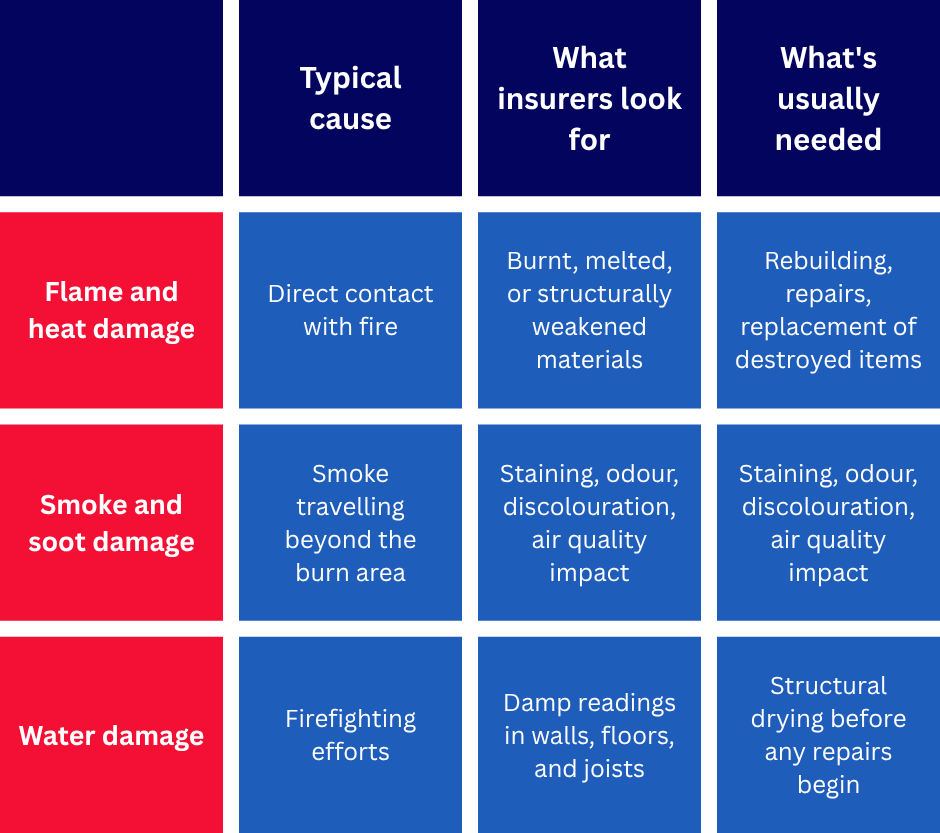
Flame and heat damage is usually the most visible and least contested part of a claim, since burnt materials are easy to document and quote for. Smoke and soot damage is harder to price fairly, because staining, odour, and air quality issues can affect parts of a property that look untouched, and insurers sometimes underestimate how much cleaning or replacement this genuinely requires. Water damage from extinguishing the fire needs its own drying survey with moisture readings, since walls, floors, and joists that look dry on the surface can still be holding damp that leads to mould or structural problems later if it isn't properly addressed.
A policyholder managing all three strands alone, on top of dealing with the emotional impact of a fire, is one of the main reasons many homeowners choose to bring in independent claims support rather than deal with the insurer's own loss adjuster unaccompanied.
In short: treat your claim as three related but distinct types of damage, not one single repair job.
What Evidence Should You Record After a Fire?
The strength of a fire damage insurance claim is largely decided in the first few days, before any cleaning or repairs begin. Insurers and loss adjusters rely heavily on the evidence gathered immediately after the incident, so it's worth being methodical even while everything feels chaotic.
Photograph and video every affected room before anything is moved, cleaned, or thrown away, including areas that only show smoke staining rather than fire damage. Keep a written or photographic inventory of damaged contents with approximate values and, where possible, proof of purchase. Retain receipts for any emergency spending, such as boarding up windows, temporary accommodation, or professional cleaning, as these costs are often recoverable under the policy's emergency and alternative accommodation provisions. If items must be discarded for safety reasons, photograph them first and keep a sample where practical, since insurers may ask for physical evidence of high-value losses.
It's also worth noting the exact date, time, and suspected cause of the fire, along with any fire brigade incident number, as insurers will cross-reference this against their own investigation.
In short: document before you clean, and keep every receipt from the first few days.
How Long Does a Fire Damage Insurance Claim Take?
Timelines vary considerably depending on the size of the loss and whether the insurer disputes any part of it. Under FCA rules, insurers must handle claims promptly and fairly, and firms are expected to keep policyholders updated throughout, but "promptly" isn't a fixed number of days.
A straightforward, undisputed claim for a contained kitchen fire might be agreed within a matter of weeks once the loss adjuster has inspected the property and a repair scope has been signed off. A claim involving significant structural damage, multiple affected flats, or disagreement over the extent of smoke contamination can take considerably longer, sometimes several months, particularly if additional surveys or specialist reports are required. Drying alone can take weeks to complete properly, and insurers are expected to recognise that repairs shouldn't begin until moisture levels have returned to a safe level, even though this can feel frustratingly slow when you're waiting to get your home back.
Regular communication from whoever is managing your claim is one of the clearest signs things are progressing as they should be. If updates dry up for weeks at a time, it's worth chasing directly or asking a professional to intervene on your behalf.
In short: expect weeks for a simple claim and potentially months for anything structural or disputed, with drying often the longest single stage.
What Disputes Commonly Arise During Fire Damage Claims?
Fire claims are among the more contested categories of property insurance claims, largely because so much of the damage isn't immediately obvious. Research behind Which?'s 2025 super-complaint to the FCA found that acceptance rates for buildings insurance claims fell well short of other insurance categories, reflecting how often policyholders and insurers disagree on scope or value.
The most frequent disputes centre on the extent of smoke damage, where insurers may want to clean items a policyholder believes need replacing. Underinsurance is another common flashpoint: if your sum insured doesn't reflect the true rebuild cost of your home, an insurer can apply "average" and reduce your payout proportionally, even on a valid claim. Disagreements also arise over whether an item was damaged by the fire itself, general wear and tear, or a pre-existing issue unrelated to the incident, and over the standard of materials used in reinstatement, particularly on older or characterful properties. Cash settlement offers can also cause friction, since accepting one before all repairs and hidden damage have been fully identified can leave you covering shortfalls yourself later on.
In short: most disputes come down to scope, valuation, and the pressure to settle before the full extent of damage is known.
How Can You Speed Up Your Fire Damage Claim?
While you can't control how quickly an insurer moves, there are things within your control that reduce delay. Reporting the fire and starting your claim as soon as it's safe to do so avoids losing time at the outset. Responding promptly to any information requests, keeping your own organised file of correspondence, and having your policy documents to hand all help avoid unnecessary back-and-forth.
Bringing in support that manages surveying, negotiation, and repairs together, rather than juggling separate contractors and insurer contacts yourself, tends to reduce delay significantly, since nothing is waiting on a handover between parties. If your claim is contested or moving too slowly, you're also entitled to escalate a complaint to your insurer and, if unresolved, to the Financial Ombudsman Service.
In short: prompt reporting, organised records, and single-point-of-contact support all help keep a claim moving.
Get Fair, Fast Support With Your Fire Damage Claim
Recovering from a house fire is stressful enough without also having to interpret how your insurer classifies damage or negotiate a fair settlement alone. All Property Claims manages fire damage insurance claims from the initial assessment through to completed repairs, working directly with insurers and loss adjusters on your behalf and taking responsibility for reinstatement once a claim is agreed. Get in touch with the team today for free, no-obligation advice on your fire damage claim.
Frequently Asked Questions
Does home insurance cover smoke damage as well as fire damage? Yes. Most policies treat smoke and soot damage as part of fire cover, but it needs to be documented and assessed separately from flame damage, since it can affect areas the fire never reached.
Will my insurer cover water damage caused by the fire brigade? Generally, yes. Damage caused by extinguishing a fire, including water damage to floors, ceilings, and plasterwork, is normally covered under the same fire claim, though drying is typically required before repairs begin.
What happens if my insurer says I'm underinsured? If your sum insured is lower than the actual rebuild cost of your property, the insurer may reduce your settlement proportionally under the principle of "average," even if the claim itself is valid. Checking your sum insured against a rebuild cost calculator before you need to claim is the best way to avoid this.
Can I claim for temporary accommodation after a fire? Most policies include an allowance for alternative accommodation if your home is uninhabitable, provided you have appropriate cover in place. Keep all receipts, as these are usually reimbursed as part of the claim.
Should I accept a cash settlement instead of repairs? Not without care. A cash settlement offered early can undervalue the true cost of repairs, particularly if hidden smoke or moisture damage hasn't yet been identified. It's worth having the full scope of damage confirmed before agreeing to any settlement figure.